At a recent somatic class with Rebekah Ballagh (Journey to Wellness), Becks invited us to practice saying ‘no’. This invitation came as the culmination of a series of gentle practices aimed at opening up our throats and releasing stuck tension from neck, chest, and jaw. Somatic practices, like those developed by Pay Ogden and Peter Levine, are designed to tap into the stories held in the body, as an adjunct to or even a replacement for cognitive therapies. Whilst the latter generally only work with the mind, somatic approaches tap into the nervous system and the subtle sensations in muscles and fascia that tell us about our emotional and embodied state. These are practices I often use with my own clients working in toxic departments to help relieve the tension that has built up in their bodies as they brace against the onslaught. I’m a huge fan of these approaches, having been, like many academics, trained to be a ‘thinker’ for many years, and yet somehow aware that my body was often communicating other demands that I needed to prioritise. I genuinely think it was this interoceptive (or body aware) practice that protected me from a more profound burnout when academia, the tail end of lock-down, and a severe crisis in my partner’s health came together in 2021. Whilst academia as a whole rarely acknowledges that academics actually have bodies, let alone that these can sometimes tell them ‘no’, I strongly believe that tapping into the soma is an experience most people in higher education profoundly need to embrace.
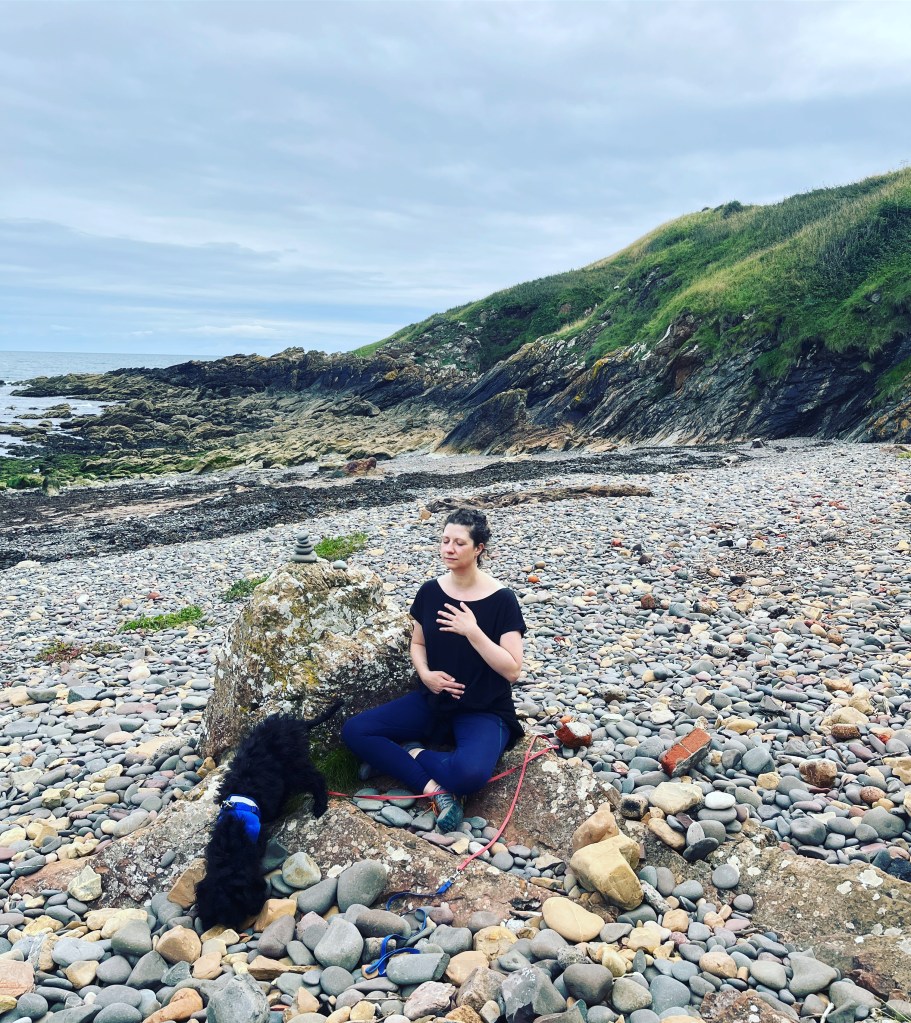
Why saying ‘no’ is challenging
What I noticed in Beck’s class was how uncomfortable I was vocalising the word ‘no’, or saying it in a way that had some kind of force behind it. Despite sitting in my study with a sleeping puppy and scented candle, muted on zoom, I still struggled to give expression to the word. My voice came out weak and unconvinced, utterly unlike the one I would use to, say, order a coffee or lead a class. The first is asking for something I know I can have, the second is a skill I am confident I possess. But why is refusing or denying something not ok for me? Thankfully for my anxious tendency to self-pathologise, everyone else on the call seemed to be having similar experiences. Responses on the chat ranged from, ‘I sound really unconvinced’, to, ‘I feel shaky and upset, my heart is racing’. It seemed that all of us, gathered as we were from around the world, were struggling to say no with any kind of conviction.
And yet, the ability to say no is an essential skill that emerges at a core stage in our development. Who hasn’t encountered the infuriating (if amusing for everyone else) toddler who has just discovered the word and is now using it for everything from having a bath to leaving the playground. Just as the child starts to become aware of good and bad, or personal likes and dislikes, so they start to experiment with their right to say ‘no’. Exhausting though it is for parents, a strong no is something all children need to be encouraged in in order to protect themselves against inappropriate or dangerous demands from others. We know that a key indicator for trauma is the denial of a no from abusers. Our nervous system is designed to keep us safe through strong somatic responses that resonate in our limbic systems and tell us ‘no’. Fight and flight are just that – defensive postures of denial and self-protection. When fight-flight is resisted or denied, we then drop into a secondary layer of protection by fawning, freezing, or collapse. For many people who have experienced abuse, it is the powerlessness, the inability to express a no that is heard, that remains trapped in the nervous system and manifests as ongoing dysregulation and fear. Beyond abuse, there are other ways we can lose touch with our inner no: time starved, exhausted parents who just need the kids to conform; living as a minority or migrant where the pressure to fit in has real consequences; enmeshed families in which one child or parent dominates; youthful caring responsibilities, or taking the peacekeeping role early in life; a toxic educational or workplace environment; or simply the quietly communicated norms and expectations of the ‘good girl’ in a culture that still vilifies assertive women as unnatural.
There are many ways in which society and those closest to us communicate that saying no is not acceptable. Over time we internalise and embody the message that self-denial and lack of boundaries is how we stay safe and secure in a world that doesn’t like us when we resist. Gabor Maté’s powerful book, When the Body Says No (London: Penguin, 2019) focuses on the implications for our physical health that come from a lifetime of never speaking up in our defense. In an early case study, Maté talks about a patient he worked with who described herself as ‘being incapable of saying no, compulsively taking responsibility for the needs of others’. Maté was treating his patient for scleroderma, and was convinced there was a link between her repressed emotional pain and the inflammatory response in her immune system: ‘Perhaps her body was doing what her mind could not, throwing off the relentless expectation that had been first imposed on the child and was now self-imposed in the adult – placing others above herself’ (p.3).
The consequences of ‘no’
I don’t need to labour a point I have made in other blog posts – academia is not a friend to academic health and wellbeing. To borrow from Elizabeth Wurtzel, the mantra of higher education in 2023 is: More, Now, Again. More publications/grants/students; delivery now/reactivity/availability; and do it again…and again…and again… This is a route to burnout, I have written about it before.
But, what if we start to tune in to burnout in a different way. What if we approach burnout as Maté suggests, and treat it as our body’s way of saying no. One of the most powerful aspects of somatic work is the way in which our bodies can tell us the truth, even as we fight to convince ourselves of something else. We can think we need to conform, we can declare that we are able to do it; but a body in burnout is letting us know something entirely different – no you can’t, not without consequences. I wonder what would happen if we were to slow down and really listen to that no instead of resisting it? What might we discover, instead of a gruelling conveyor belt system that saps our energy and health whilst offering so little in return? Maybe – the space to think about new creative pathways to research; the chance to envision an alternative to the current patterns of relationship in the department; a refined and reduced pallet of priorities that opens up energy for something entirely fresh and energising in life.
For those of us who have not practiced or been encouraged to say no, our inner sense of yes and no may be a little faulty. Those long held stories cut grooves in our responses that become reflexive, pushing us toward patterns that may have appeared to serve us well in the past. But our bodies can be a starting point to finding truthful responses again. I have recently been working with the wonderful creative coach Elizabeth Gaubert to explore how academia created some faulty wiring in my writing process. For years (and I do mean years) I have held the inner belief that to be ‘an academic writer’ I needed to be at my desk in the morning, cranking out the research before committing to anything else. A lovely theory. And one I clung to with an almost religious intensity despite the fact that I CANNOT write in the mornings. Throughout my PhD, into the early years of my career, all the way to starting this blog, I remained convinced that if I wasn’t prioritising writing in my day then I was failing as a writer. The result…. unbelievably slow writing. Like, turgid. What’s even slower than that? I ‘knew’ that when I wrote in the evenings the words flew from my fingers, beautifully formed and pleasing as they hit the page. But I also ‘knew’ that real academics write during the day in nice sensible ways with notes and plans and refined arguments. What was my body doing in the midst of all this? Frozen. Heavy. Sluggish. Desperate to move. Unable to find the words. My body was pretty clearly telling me no. Working with Liz has helped me to admit that my body holds an entirely different story to the one I have been masochistically treasuring for years. Now I take the dog to the park, prep dinner, and whilst it cooks I write. And… it works.
And this is what ultimately struck me during Beck’s somatic class – saying no feels scary when we haven’t been allowed to do it, it feels like cutting things off or risking major losses. But a no always creates something else, the potential to say yes. This is the lie behind the culture of never saying no, that by saying it we are going to lose out, become less. But any toddler will show you that saying no is also about wanting to say yes to something else (no to broccoli, yes to ice cream!). When I started saying no to academia I discovered that my research on trauma and my training as a coach could be channeled in another direction, which became Beatha Coaching. When I said no to yet another academic journal submission, I discovered that I could write more freely and for many more readers on this blog. Now I’m saying no to someone else’s normal of writing practice, and discovering I can write in the evenings and finish the day feeling satisfied and fulfilled. What might saying no do for you?
Starting again with no
If, like me, you struggle with no, here’s a simple exercise to help you get started. It’s all about checking in with your inner toddler and allowing them to have a say for a while. Start somewhere small, your order in the coffee shop, or what you are going to wear tomorrow, or whether to have a bath or a shower. Line up a couple of options for yourself – the automatic habitual choice, and something a bit more sparkly – and just take a moment to check in with yourself. You could even place a hand on your abdomen and another on your heart to help yourself turn inwards. What are your thoughts saying? And now, what is your body telling you? When you look at one option, and then the other, how do you feel? How does your body react? As you practice this, and practice following through by saying yes and no in response to these cues, you will find they get easier, and louder. Maybe you’ll start noticing them in departmental meetings and when you’re checking the WAM too…(just saying…). If it feels scary to say no, take a few slow deep breaths, extending your exhale longer than your inhale, and ask yourself – by saying no to this, what could I say yes to instead?
If you would like help with saying no (and yes) in academia, membership in Beatha Coaching Community is currently open, with staggered pricing depending on your career stage: £12/£14/£18. Monthly group coaching, a monthly sector specific workshop, and a weekly co-writing hour, as well as discounted 1-2-1 coaching with me, all worth £60 a month. Come and join us for community, support, and mental health informed coaching to help you thrive not just survive in academia.
Get in touch
I’m always keen to create material that will best serve my readers – if you have a topic you would like me to cover, or want to ask a question about this blog post, please get in touch:


 Beatha Coaching
Leave a comment