updates and AI Anxiety in Academia workshop

Dear friends
It has been a mad couple of months. Even though I have officially left academia, it turns out I am still operating within the norms of the HE calendar. I feel as though I just finished the spring semester and am wrapping up the last of my marking before the summer! I hope those of you for whom this is reality are feeling well and can see the end in sight.
In part my spring has been so busy because of the nature of the work I choose to specialise in as a coach. I have been delivering workshops for PGRS and academic supervisors, as well as starting new coaching packages for clients with institutional support. And that means remaining tied to the university financial year – everyone needs their budgets spent by the end of June. Good news for the self-employed coach and trainer, but a little hectic. A large chunk of my work this term has been taking place at my local university in Stirling, thanks to the farsightedness of the incredible Karen Sutherland who hired me when Beatha Coaching was newly formed to design and deliver a package of coaching workshops for postgraduate candidates. Her wonderful colleagues in the Institute of Advanced Studies have continued to develop Karen’s vision and this year saw the addition of some new workshops. As trauma informed care is starting to be talked about more in HE I thought I would share a bit of the work I do at Stirling in this newsletter. It might inspire you with thoughts for your own departments (and you can always hire me if you fancy!)
Initially Karen and I designed a six session coaching programme that would help PGRs engage in a different way with the common challenges of postgraduate research, like procrastination, receiving feedback, and avoiding burnout. Typically postgrads receive excellent skills training and academic support, but may get contradictory or un-nuanced advice about working with their own capacity, wellbeing, and neurological wiring. The coaching programme at Stirling focuses on some basic nervous system education like recognising when you are in fight/flight or freeze and what to do about it, as well as reframing that highly critical inner voice most PGRs develop as standard within the first twelve months. This year was the third year we have run the sessions and I noticed some interesting shifts in the issues being brought to coaching. In particular, for the first time I experienced some resistance to the idea that nervous system regulation might an important component of mental wellbeing and intellectual work – quite a few candidates came to me looking for a diagnosis, which I think points to the general rise in awareness of neurodiversity but also a slightly worrying desire to identify something ‘wrong’ (and therefore treatable) in themselves when they struggle.
A huge part of the work I do at Stirling, and in coaching more widely, is providing reassurance that challenges are normal. That’s why we also offer monthly stress relief sessions alongside the coaching programme that any PGRs can attend, combining somatic therapy tools, CBT, a bit of psychoeducation, and some basic yoga to help the attendees feel more relaxed and also more empowered to make changes in their everyday experience of postgraduate life. Over the course of the six months there are always a few participants who really engage with coaching and love the changes it offers. To support them Karen and I went on to design a seven week training programme in peer coaching, which I’m currently running for the second time. I really love this aspect of the work I get to do. The participants, of whom there are four this year, commit to watching a short video lecture each week explaining the core principles and skills coaches use, and then undertake live coaching practice with each other receiving guidance and feedback from me. Halfway through the course they are asked to recruit a coaching ‘client’ and offer three coaching sessions to them. Of course, as well as becoming great listeners and thoughtful coaches, the participants also learn so much about themselves in the process of the training, and leave with valuable skills for self-management and for their future careers in or outside the sector.
What I most often hear from the postgrads I work with is how much they wish they had known these things earlier – simple knowledge about how our nervous system reacts to threat, how to use CBT based prompts to understand why a relationship with a supervisor is strained, or how to gently move in ways that can ease anxiety and help release procrastination can change the experience of the PhD. At heart, what I offer is a trauma-informed approach, knowing that academia is a tough place to be at the moment and that capacity shifts and changes with context. This is also an approach I offer to PhD supervisors at Stirling. Last year I designed and ran a two hour training on basic mental health skills for supervisors, and this year we followed it up with a two hour confidential coaching session. The topics that were raised were things like safeguarding when a candidate is emotional or even physically threatening, supporting a candidate with neurodiversity, clarifying whether a candidate is aiming for the same goals that the university system ‘assumes’ they are aiming for when they undertake a PhD (hint, not all PhD students want to become academics…), and how to care for themselves when the candidate is struggling. Off the back of that session I am developing a new one hour workshop for June about preventing burnout for supervisors, and we have an idea for a new training on neurodiversity for next year. More recently I have been approached by the PGR Dean of one school to offer a workshop for their PhD students on ‘stuckness’ with a specific somatic aspect to it, and I feel very inspired and excited about designing that workshop.
So in the midst of chaos and challenge in the sector, it has been really good to see the team at the IAS continue to invest in wellbeing training for staff and PGRs. In turn I hope that each year I offer these workshops and classes I can been seeding some new ways of being in the sector. It doesn’t have to be the exhausting, debilitating grind that it so often seems to be at the moment. Humane, engaged, energised academics are needed more than ever in a world that continues to look for simple answers to complex problems. Let me know what I can do to keep supporting to you to offer something different without burning yourselves out.
Francesca x
Workshop on AI Anxiety
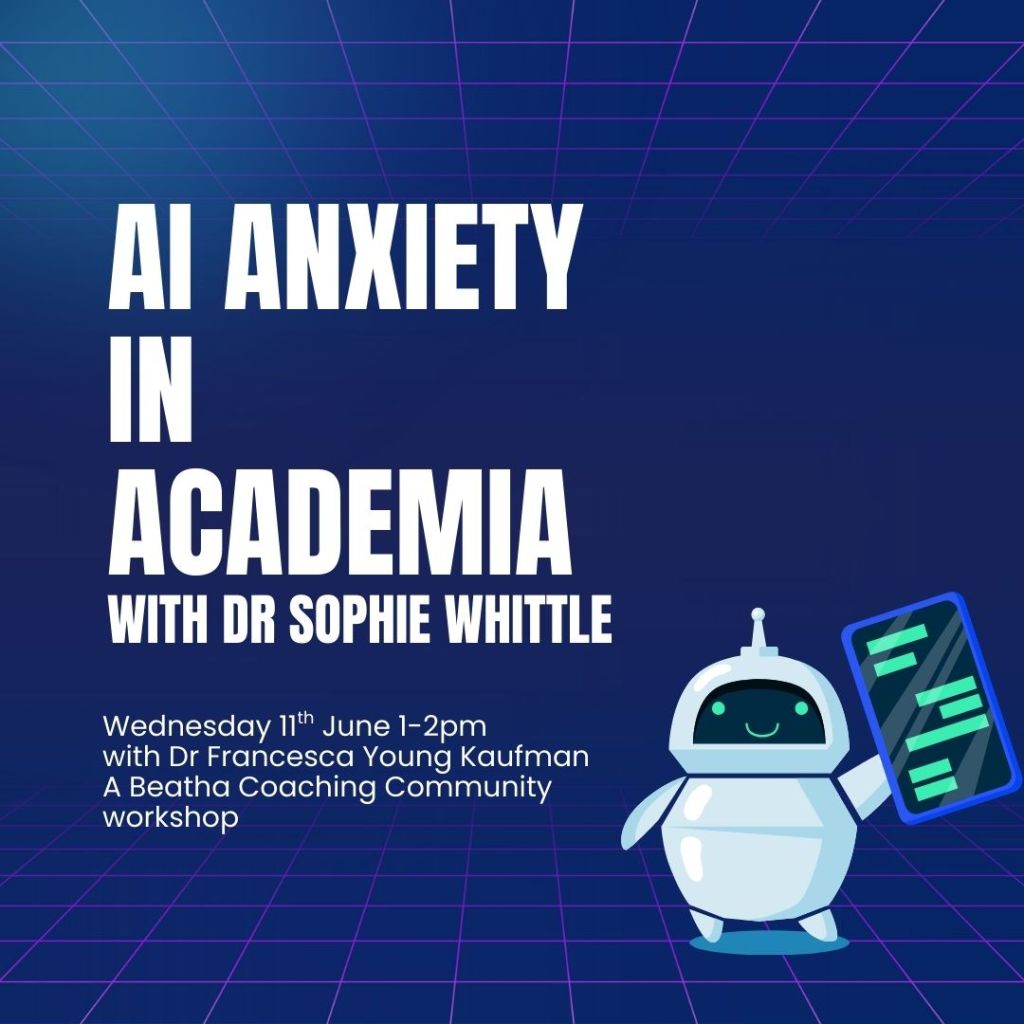
Beatha Coaching Community is incredibly fortunate to count Dr Sophie Whittle from the University of Sheffield’s Digital Humanities Institute among its members. Sophie has a PhD in historical linguistics and now researches large language models and their impact on scholarship.
You would have to be living under a rock not to have become aware of the advance of AI in universities, with over sixty AI-related student expulsions having taken place at one Scottish institution this year. Unlike most of us, however, Sophie really understands AI, as well as the anxiety about it that is understandably making teaching in HE even harder. In June’s coaching community workshop Sophie will be guiding us through the murky world of AI and offering guidance for anyone feeling anxious about how to move forward in teaching in a chat-GPT world.
This workshop is free for all Beatha Community Coaching members, but if you would like to drop-in to learn from Sophie and ask her some questions you can register for the workshop here. I am charging a drop-in rate of £10, which will go toward compensating Sophie for her time. It would be great to see you there.
Join us on Wednesday 11th June for AI Anxiety in Academia:
And lastly…
I’ll be back later in the month with updates about what I’m offering this summer. But in the meantime, I know many academics struggle with gut problems and discomfort, especially around the busier or more stressful times of year. This week I ran a workshop on Stress and Gut Health for the coaching community, and I wanted to share it with anyone who might find it helpful. The workshop lasts one hour, and you can watch it here:
PLUS: on Thursday 22nd May at 5pm I’ll be offering a LIVE YOGA for GUT RELIEF class via zoom. The class will be recorded and subscribers to Mind-Body-Movement (my online movement platform) will have lifetime access. But even if you aren’t a subscriber you are welcome to join the live class. Just reply to this email and I’ll send you the link.

 Beatha Coaching
Leave a comment