Burnout in academia AND 24 hours to claim early bird on the Summer Coaching Programme
Dear friends,
It’s hard to believe we are half-way through the year, but this weekend marks the summer solstice and all that that entails – heat, light, endless nights, and the imperceptible beginnings of our shift away from the sun. I always feel like July and August are months ‘on pause’ when the growth and aliveness of spring meets its fullness. Everything is at its most luxurious and overblown, and autumn still feels a good way away. Or course, we are, in fact, still moving, and like many academics I also think of summer as an opportunity to write, and to catch-up with writing. An ambition often stymied by family demands, waiting for confirmation of work in September, unexpected administration, and the attempt to have a ‘meaningful’ summer holiday.
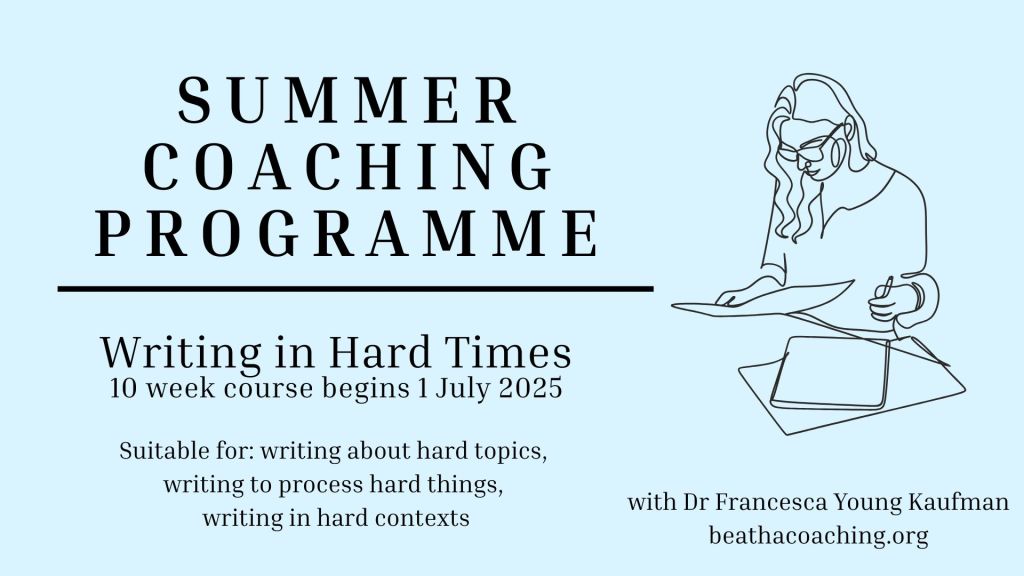
This year I’m running the Summer Coaching Programme as a means to support others, and myself, with writing at a time when it may feel hard, or perhaps because we encounter so much in the writing that drains us. Writing in Hard Times is a ten week programme of weekly prompts, co-writing hours, group coaching and individual support. There are only 4 places left! And the early bird price of £299 (£100 off) will expire tomorrow. If you have been considering joining, or now think that support for your writing would be welcome, please head over here to find out more and reserve your place. I really look forward to writing with you.
Burnout in Academia
Last week I ran my last training of the year for the University of Stirling – a wellness seminar for PhD supervisors about burnout. Whilst the brief had been to explore ways to be healthy as a supervisor, within the first five minutes it was obvious that my breakdown of what burnout is and the key symptoms was hitting a nerve. People were nodding, putting their heads in their hands, and showing signs of being obviously distressed. It was a reminder for me that whilst I swim in the mental health awareness seas all the time now, academia is still a space in which the realities of our bodies and nervous systems when under strain remain largely undiscussed. Especially at the moment, with sector-wide redundancies or threatened redundancies, increased teaching loads and decreased research freedoms, so many academics and professional staff have been soldiering on and surviving. It’s what we have to do, what we are uniquely well designed to do, but it still carries a cost. And because burnout is cumulative and worsens over time, we often miss it until our bodies really start to act up.

The three key symptoms of burnout, as defined by the WHO, are:
- Work-related fatigue, that may spill over to other areas of life
- Depersonalisation, cynicism, and loss of empathy
- Loss of hope, or loss of belief in personal efficacy, and loss of passion
Parker at al (2021) asked over 1000 professionals in demanding jobs who self-identified as burnt out what their symptoms were. You can see that exhaustion and shifts in mood and personality were the most widely reported symptoms. Far fewer noticed the physical symptoms, and yet by the time we are exhausted enough to note significant fatigue and low mood we will have been in a state of high stress and burnout for long-enough to have depleted the physical resources that enable us to keep functioning. In other words, the physical symptoms of burnout often appear first, but are disregarded or go untreated because of the tendency in highly stressed people to dissociate. This ability is one of our most adaptive survival strategies, it allows us to (literally) numb out by reducing sensation from our nerve endings. If you have ever lost yourself in a daydream on a journey or done hard physical activity whilst listening to music you have dissociated. You can see the advantage in an emergency where you need to just keep going regardless of physical exhaustion or pain. Unfortunately, academia (and other high pressure high reward jobs like medicine and law) is not an actual emergency, it just functions like one. We are pushed into survival states to get through the semester, and so reach the end of the year as depleted as if we have experienced a series of major traumas. There is also the other factor we need to consider – the tendency of certain personality types to be attracted to (and contribute to) these type of workplaces. Type A personalities, high achievers, high functioning perfectionists, are all usually champion dissociators, walking around carrying a range of physical and emotional wounds they aren’t dealing with (no shade intended, I’m one of them myself).

So here’s the jolly jolly list of standard physical ailments that come with early to mid-stage burnout. Have fun identifying how many you regularly experience. My point here is not to depress you or to heap on shame, but rather to point out that before you leap into summer with all its potential for productivity, take a moment to check-in with how you are really feeling. It may be that there are warning signs your body is giving you that need attention. I offer burnout support through 1-2-1 coaching and somatic therapy. But burnout may also indicate a trip to the GP to get some blood tests done, a visit to a nutritionist to find solutions to your mood and gut problems, support from a physio or PT to find ways to move more safely, or a call to your occupational health department to get accommodations and support logged with your HOD before the next semester begins.
Above all, burnout is a collective disorder, because it emerges in workplaces that foster cultures of individualised responsibility, heavy workloads without built-in redundancies, competitiveness over collaboration, and hierarchical power structures. As well as, of course, precarity, moral injury, and a disconnected management. Fun times. So long as we continue to accept the terms of the work, and tacitly agree to them by working through burnout, there will be no impetus to change the sector. If you can, therefore, the biggest change you could make would be to build a network of support within and outside of your institution focused on the shared goal of participating in practices of wellbeing inside HE. And if you can’t find your own community, and you identify as a woman in academia, by all means come and join ours at Beatha Coaching Community. There is a group coaching call this Friday, send me a message if you would like to attend and try it out.
If this newsletter has resonated with you and you would like some next steps, I strongly recommend Claire Plumbly’s Burnout (2024). I also recently filmed all three sessions of my own course, ‘Burnout Rewire’ for Journey to Wellness, which you can purchase here. The most important thing to remember about burnout is that it is physical, which means it is repairable. It is 100% possible to recover from burnout and its effects, you may just need some time and some support to get there. Do reach out to me if you have any questions.
Sending lots of love your way
Francesca x


 Beatha Coaching
Leave a comment